
Stories from Earth
Murals and memories of the Matsigenka identity

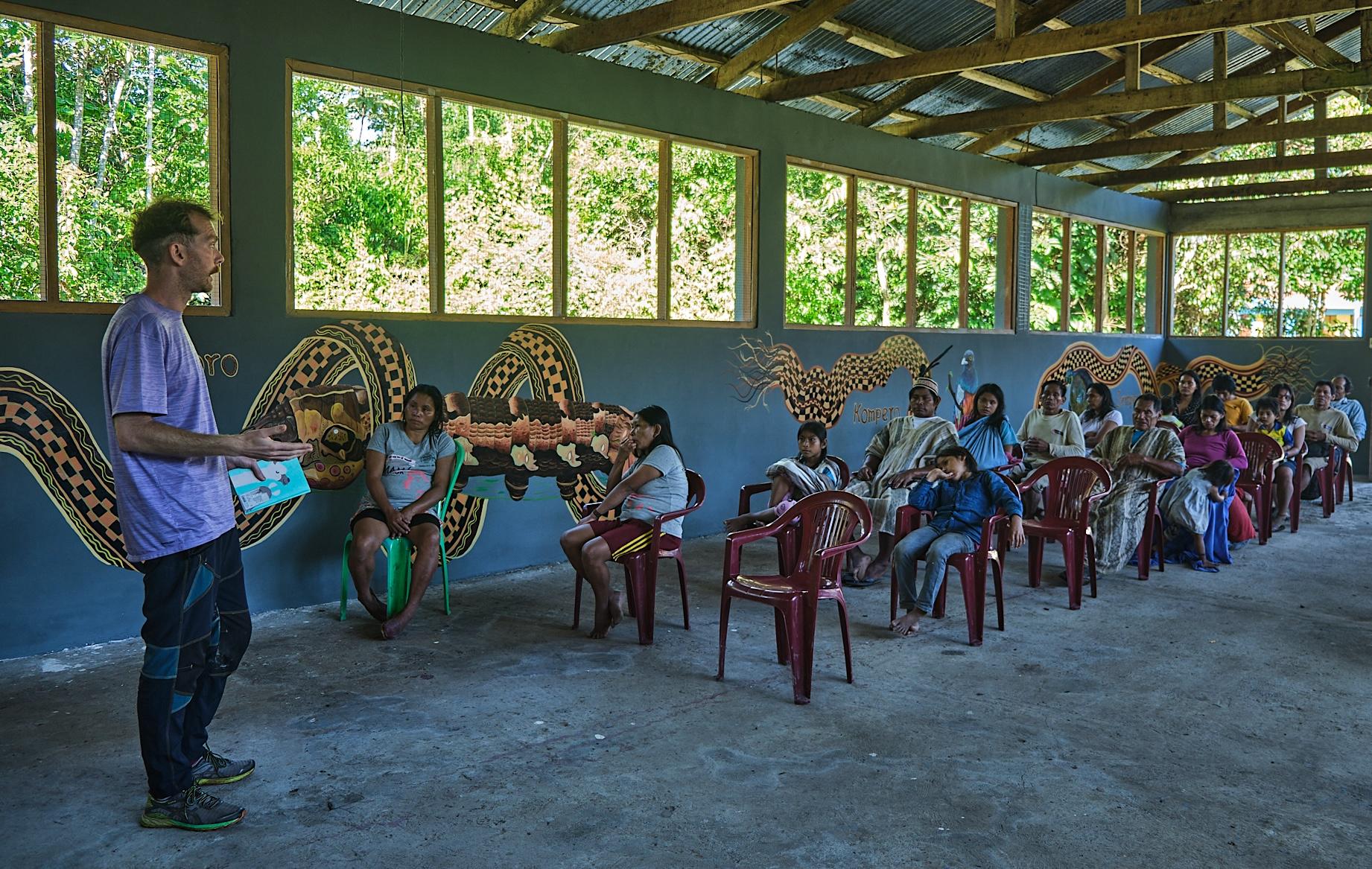
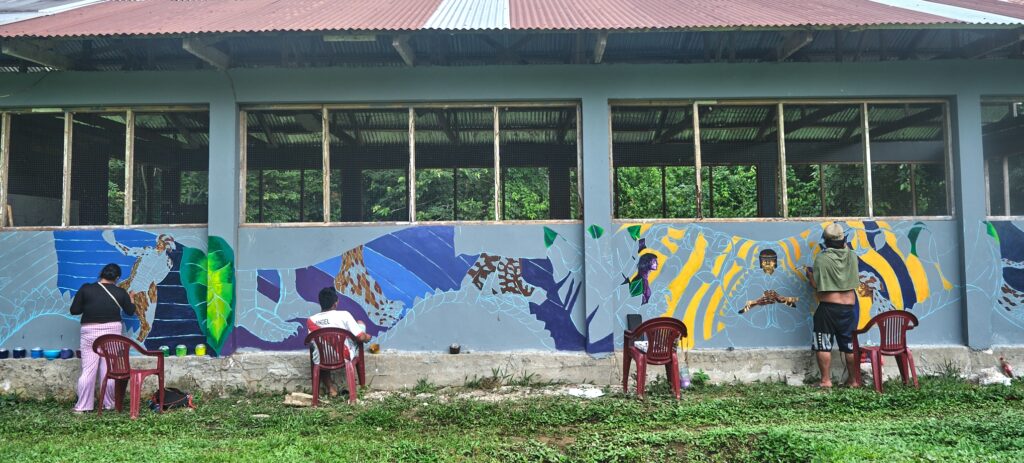
The Matsigenka worldview holds profound meanings about the relationship between humans and the forest. This connection is expressed in their iconography and ancestral tales, which safeguard vital memories for their culture. It was precisely this symbolism that captured the attention of Xapiri Ground in 2021. This interest, which began with an attentive listening to the stories and knowledge of the Matsigenka community in the Manu Reserve, gave way to the collective creation of six murals that today cover their community hall with the identity and strength of their territory.
© Xapiri Ground
The Matsigenka are an indigenous people of the Peruvian Amazon who mainly inhabit the Urubamba and Manu river basins, in the departments of Cusco and Madre de Dios. A fundamental part of their culture, like other Amazonian peoples, is their close relationship with the forest as a source of life. In their tradition, all living beings keep a balance, and human beings are part of a universe where there are higher and lower levels inhabited by various spirits and gods. The territory that these people have guarded for centuries remains, to this day, an exceptional ecological space, home to some of the most biodiverse ecosystems on the planet.
As part of the Regenera Alliances Network, which accompanies the Matsigenka guardian community of Shipetiari (Manu Landscape), is the NGO Sé Perú, led by Patricio Zanabria. Motivated by his desire to promote the handicrafts of this culture, Patricio says that, upon visiting the Xapiri Ground showroom in Cusco, he decided to approach the team and propose a collaboration. Xapiri Ground, a contemporary art space located in San Blas, promotes the living cultures of the Peruvian Amazon through joint creation and the strengthening of ancestral knowledge. From that meeting, artist Deivis Torres and Jack Wheeler, director of the organization, traveled to Manu to initiate an exchange of learning about the iconographies and stories of the Matsigenka people.
Some of the elements that have marked the development of this co-creation is the perception of time and the community. For the Matsigenka culture, time is vital, because through long hours of dialogue and sharing, the stories and knowledge that sustain this community are transmitted. However, with the passage of time and the challenges of modernity, these meeting spaces have become increasingly scarce, weakening the dialogue between generations. To address this situation, Xapiri Ground proposed the “Storytellers” project, which combines art and storytelling to bring young Matsigenka people closer to the oral traditions of their elders through creative workshops, thus strengthening ties with their cultural identity.
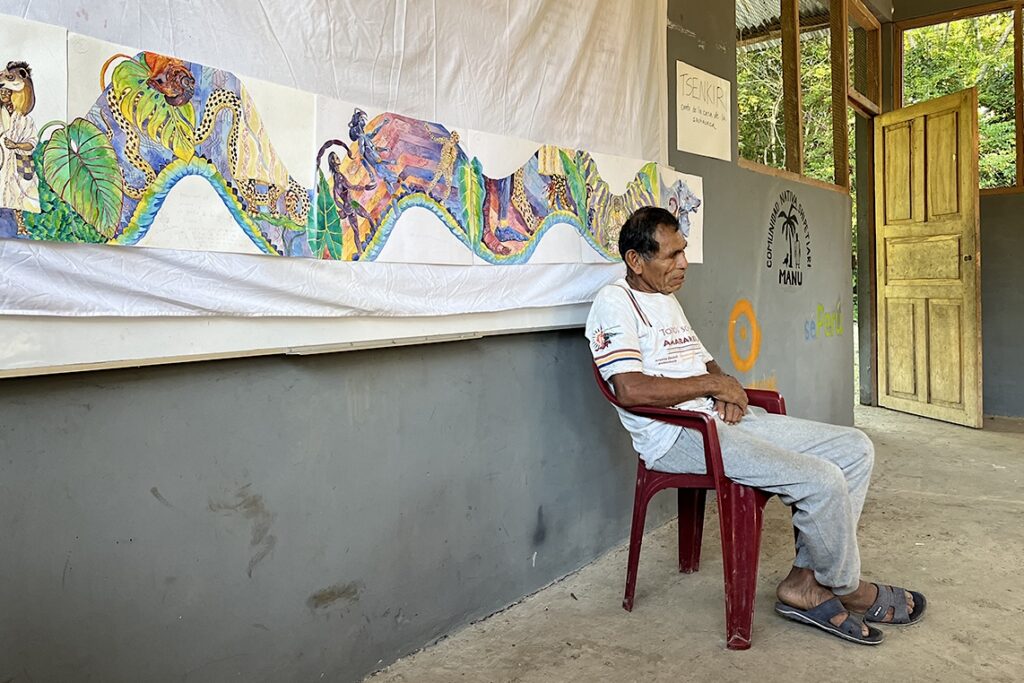
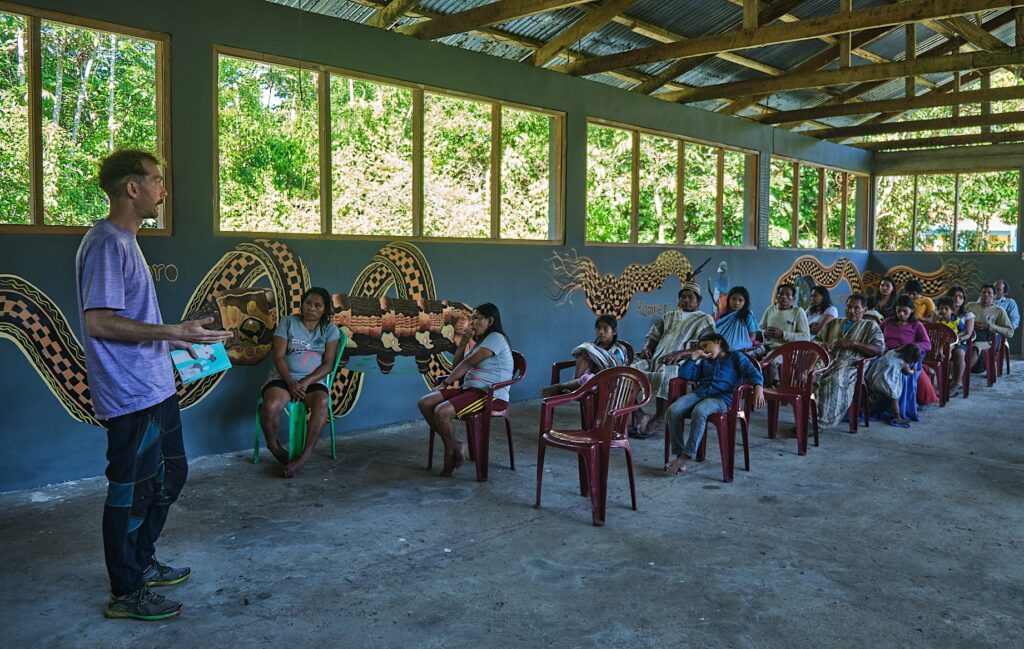
This work gave rise to the idea of capturing some of the stories in murals: an impressive and collective format, not only because of the physical space it occupies, but also because of the broad participation it attracts. The experience was careful and patient. Although there were a large number of designs and stories, we selected those that had the deepest connection with the elders who were the bearers of knowledge. They not only told the stories to the younger ones, but also drew the representative images and characters.
David tells a story to the community / Photo credit: Melanie Dizon © 2024 Xapiri Ground.
From these inputs, Deivis Torres developed the sketches, which were then reviewed with the community. Everyone interested in participating was invited: women, men, girls, boys and young people. For the artistic team, it was deeply enriching to see how the youngest participants asked about the images, became familiar with painting and transformed their initial shyness into enthusiasm, confidence and creative freedom. The painting was carried out in two stages, each lasting one month.
Today, the murals occupy a symbolic and strategic space. The meeting room – where visitors, tourists and community assemblies are held – has become a living place of memory and dialogue. During these meetings, observing the images and asking about their meaning has become an excuse to open the conversation and strengthen cultural transmission. In addition, Xapiri organized an exhibition in Cusco, which was attended by a Matsigenka delegation to share their stories and experiences.
Regenera
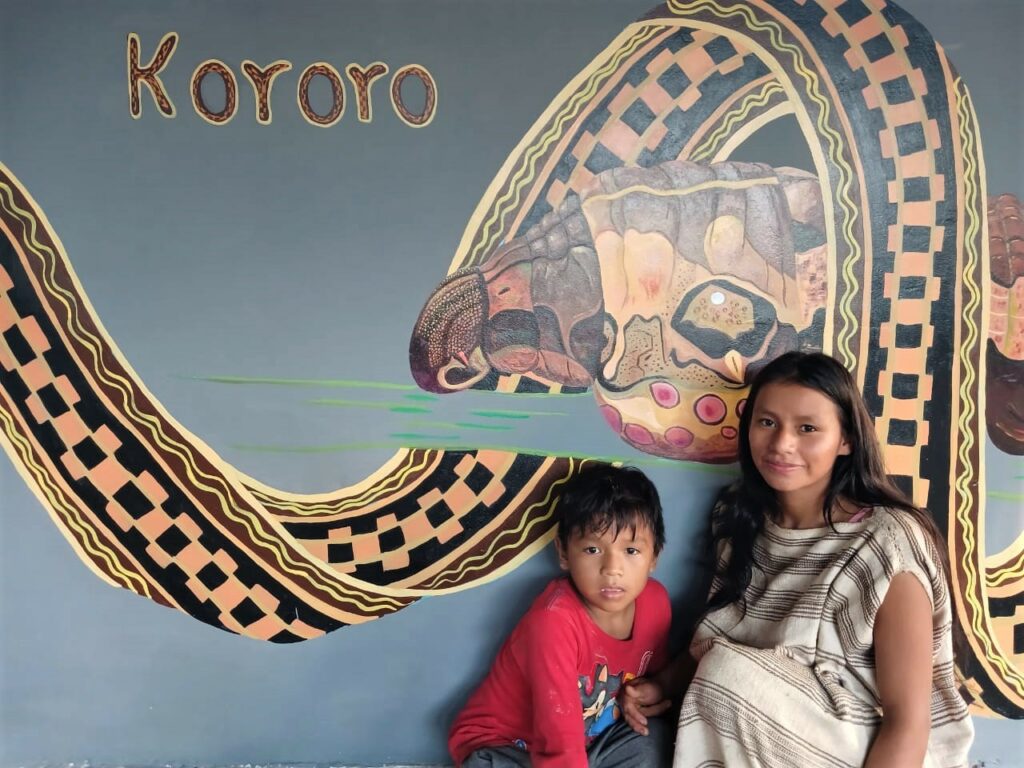
This experience also bore other fruits: the reinforcement of the collective identity has inspired more young people to return to wearing the kushmas, traditional garments made and dyed with plants from the forest, which carry the iconography that expresses the identity of the Matsigenka people.
Projects such as this one are essential, because the care of the rainforest depends to a large extent on the indigenous communities and the knowledge they have preserved for centuries. For Jack Wheeler, co-creation experiences like this are valuable because “it is not possible to imagine forest conservation without the Amazonian peoples. Their culture is an essential part of life in these territories”.
Similarly, Rani, an elder of the community, comments in a testimony collected by Xapiri that this initiative has helped her people to collect the stories of their ancestors to share them with the children, so that they are not lost and can learn about the lives of those who preceded them.
Finally, Patricio Zanabria reminds us that Amazonian communities are vital to the defense of this territory. Initiatives such as those promoted by Regenera not only strengthen their identity, but also provide economic recognition to the community members who watch over and protect the forests.
© Xapiri Ground
Etiquetas
- Nature connection
- Forest Guardians
- Amazon
Artículos relacionados
- Historias de la Tierra
- Manu
Leer artículoDiez años después, volvimos a donde todo empezó
Enrique Zuñiga
- Aliados en Acción
- Machu Picchu
- Manu
Leer artículo¿Cómo reducir el impacto de construir? La pregunta detrás un nuevo hotel en Machu Picchu
Margony Palacios
- Aliados en Acción
- Manu
- Machu Picchu