
Living Nature
Nature connection in Manu National Park

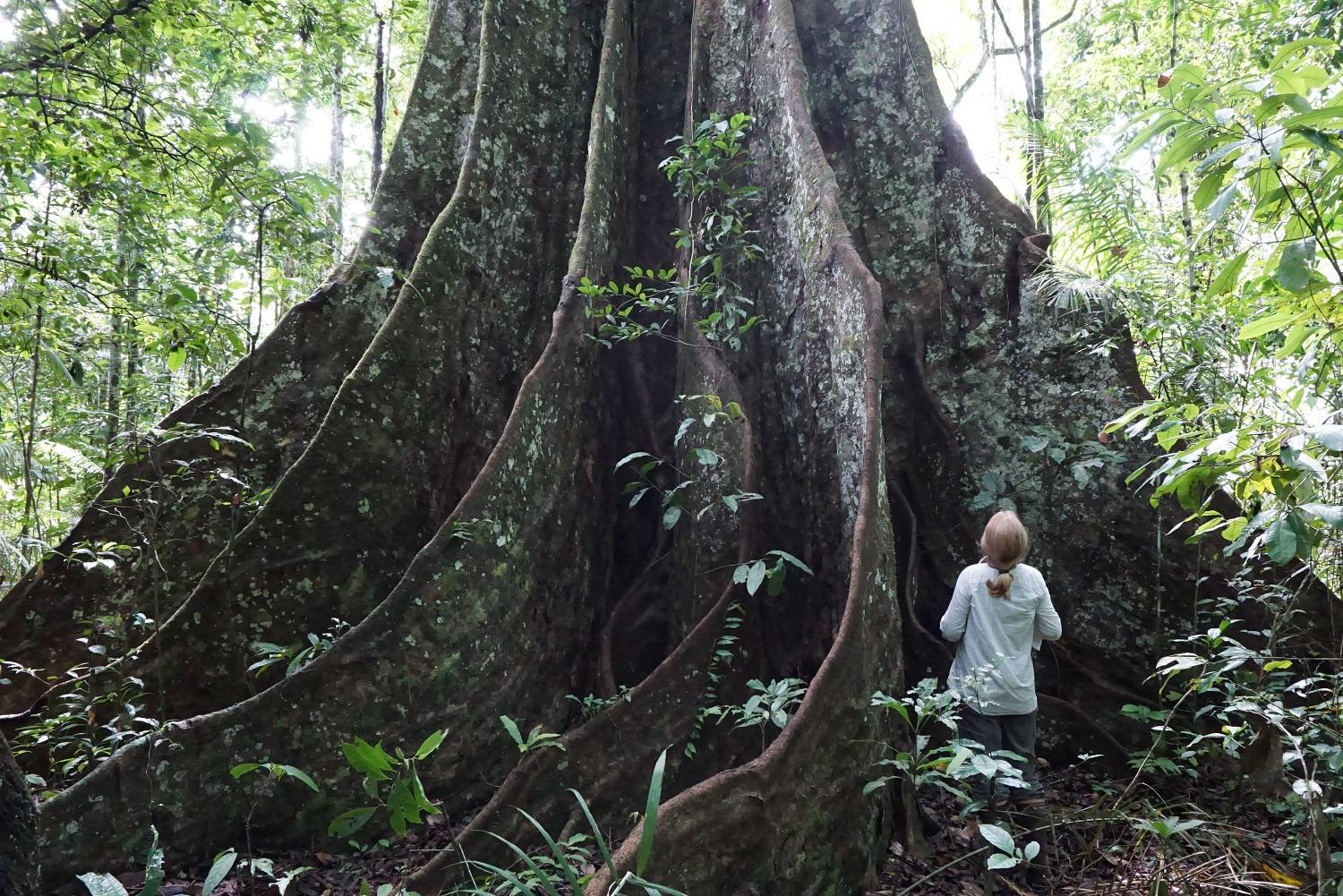
Featured image: Nature connection (photo Jessica Groenendijk)
I’m generally a watery person, but I’ve always liked forests and in my fourth decade of life I especially came to appreciate the beauty of individual trees. There’s a mulberry tree in my garden at home, with large leaves and drooping branches, the sight of which gives me pleasure daily. In summer I sit in the green shade of its umbrella-like embrace and write.
The Avatar, so-called by staff after the blockbusting film, is the most impressive tree, if not the largest, within a day’s walk of the Cocha Cashu Biological Station in Manu National Park. I was told it is of the Sloanea genus. Seeing the Avatar was like entering the Notre Dame cathedral; it made me want to take my hat off and whisper. The immense trunk rose before me, metre after metre, forcing me to tilt my head right back and my mouth to fall open. High above, it flared into a vaulted ceiling of thick, spreading branches. Sunlight filtered through its lofty crown. I walked slowly around it, and between the sinuous flanges of its buttresses, my feet sinking into dense leaf litter. Try as I might, I could not find a camera angle that adequately captured the tree’s towering dignity.
When I was offered the opportunity to climb The Avatar, I didn’t hesitate. The rope was already up. After a crash course in climbing technique (I’ve now forgotten most of the names of the kit involved, though ‘carabiner’ and ‘ascender’ stick in my head), I found myself doing a kind of aerial caterpillar act through the foliage. Move the doodah up with right hand, bend legs, push down hard on rope loop, arch back, and up you go! Something like that, anyway. From below it must have seemed like I was suffering the effects of the Cruciatus Curse.
Though I got the hang of it quickly, it was much harder work than it looked. Mid-way, a sweat bee flung itself into my right eye (they don’t sting but their suicidal tendencies are infuriating). Fortunately, I could disguise my frequent rest breaks as moments of appreciation of the changing panorama around me.
Once I’d cleared the understory, I felt airborne. By kicking my legs strategically, like Peter Pan, I could turn a full circle and gaze through the canopy. This, then, was the world of the harpy eagle and the spider monkey. But also, of epiphytes. The branches around me were carpeted with lush mats of vegetation: mosses, lichens, ferns, orchids, and bromeliads. These plant mats support rich wildlife communities and become established only on the thicker branches: thus, the older the tree, the older and more diverse the mats it hosts. I spotted a bat flickering to a new hiding place and black ants crawling along a branch, reminiscent of slow-motion cars in a view from an airplane window.
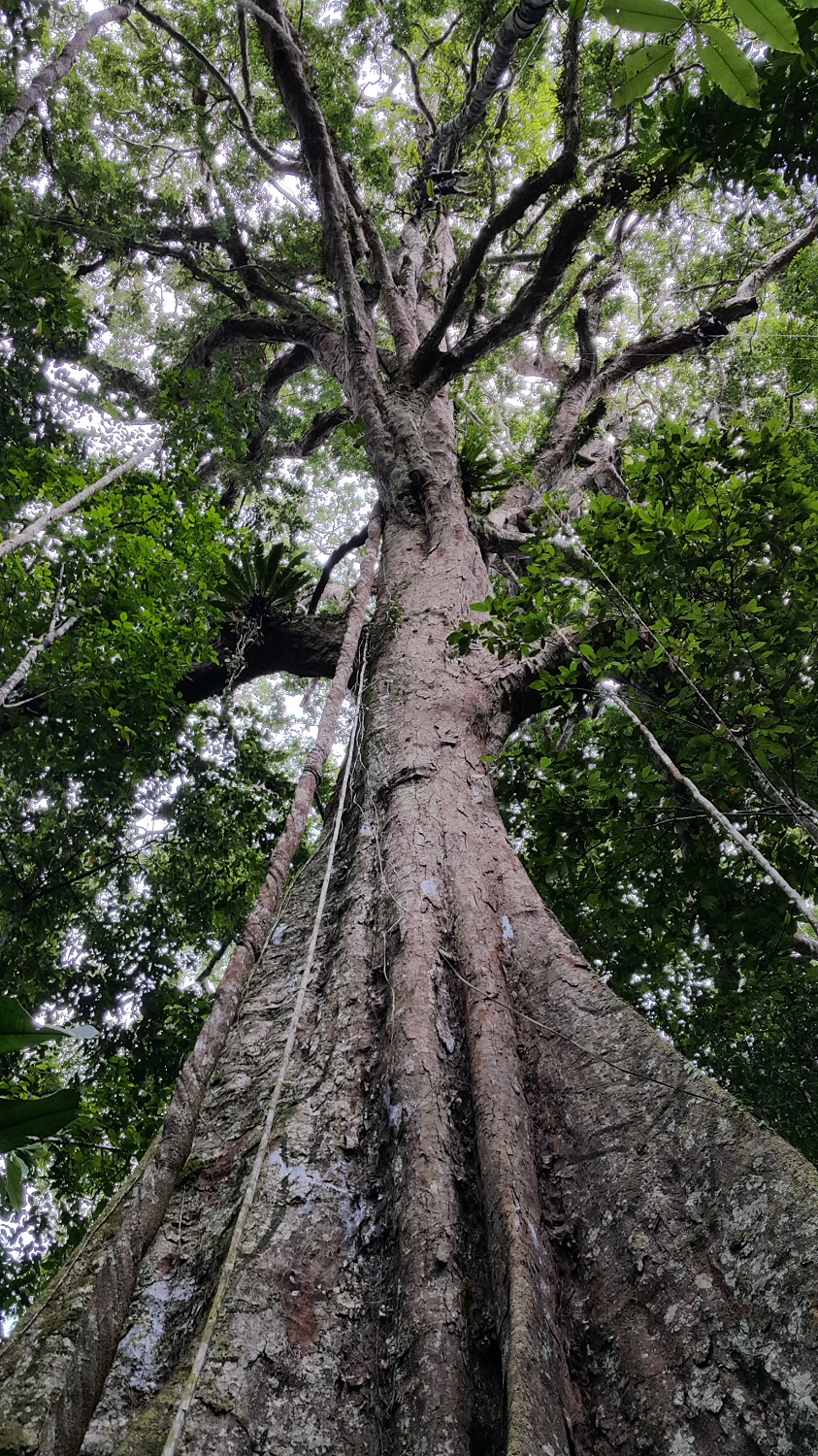
The ascent
When I was about thirty metres above the ground I could go no further, though at least another ten metres of tree stretched above me. I raised my hand and gave the huge branch to which my rope was tied a reverent pat. The Avatar seemed benevolent, even friendly. Call me fanciful, but I was deeply conscious of it not as an inanimate, aloof object, but a living, breathing, sentient being. An elder, with stories to tell if only we would listen.
Reluctantly, I agreed it was time to go down. This proved much less tortuous than going up. So easy, in fact, I felt like I was floating. The sensation made me think of scenes from Planet Earth, where the camera pans through the dappled canopy, smooth and effortless, and you wonder how they do that. For a few seconds, I was that camera. And I will not soon forget the footage I filmed in my mind’s eye that day.
Etiquetas
- Nature connection
- Trees
- Cocha Cashu
Artículos relacionados
- Historias de la Tierra
- Manu
Leer artículoDiez años después, volvimos a donde todo empezó
Enrique Zuñiga

- Aliados en Acción
- Machu Picchu
- Manu
Leer artículo¿Cómo reducir el impacto de construir? La pregunta detrás un nuevo hotel en Machu Picchu
Margony Palacios
- Aliados en Acción
- Manu
- Machu Picchu