

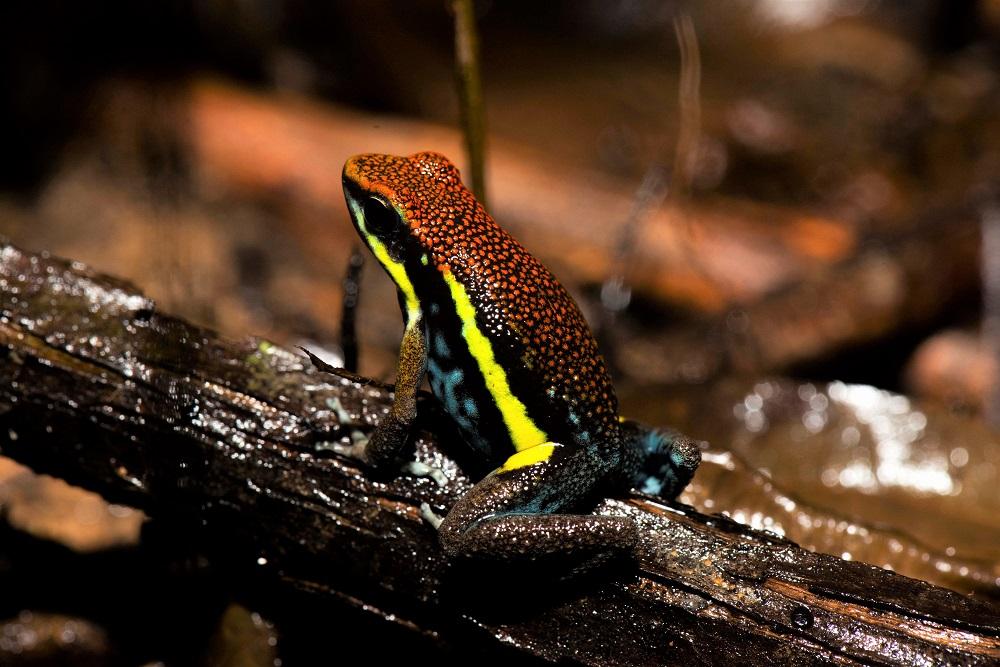
The Manu poison frog (Ameerega macero).
“Through adversity to the stars.” This is a saying that I have repeated to myself many times during the long years I have been walking in the Andes. It is a Latin expression attributed to Seneca, the young man who spoke of the courage and effort required to achieve success, and it is an appropriate title for this chronicle.
It is my last day at the Cocha Cashu Biological Station, and Fortunato Rayan Perez, assistant administrator, passionate photographer, and one of the best adventure companions in Manu, has decided that we will go in search of a jewel that inhabits these dream forests: the Manu poison frogAmeerega macero).
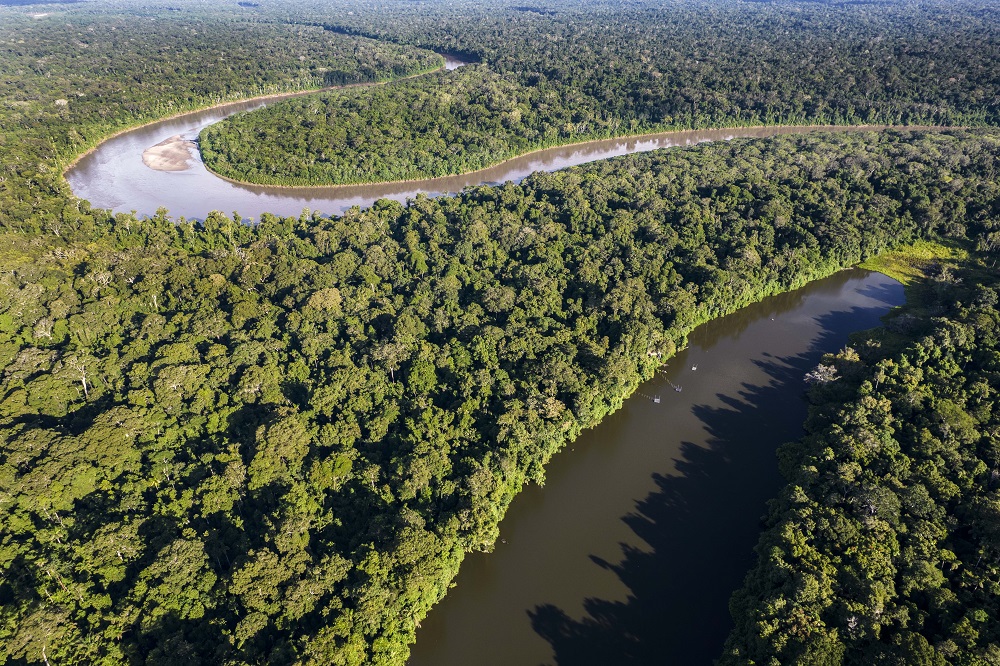
An aerial view of Cocha Cashu (in the foreground) and the Manu River (in the back).
The journey begins by crossing the Manu River, guided by the expert hand of Mario Cruz, the Station’s boat driver and a great connoisseur of these forests. A few minutes later, we climb up the right bank of the river and take a narrow trail through a dense forest of reeds and heliconias that delight us with their colourful inflorescences. A pungent smell tells us that a herd of white-lipped peccaries has recently passed through in their incessant search for food. The distant sound of thunder suddenly announces the arrival of a heavy rain which begins to fall a few minutes later. With our cameras protected under waterproof ponchos, we meander along the path, which soon turns into a muddy track that makes me stumble. But that’s not the worst of it.
To reach the ravine where our colourful little frog is located, we must climb up and down several slippery ravines, carrying eight kilos of equipment and under a poncho that drenches your body with sweat. Several times I have to crawl to avoid falling with all the equipment, and going up becomes a struggle because of the mud and water. At one point I ask myself, what am I doing here? I’m exhausted, wet, I can hardly see through my glasses, I’ve fallen several times, and the rain is getting heavier and heavier. And we will have to retrace our steps to return to the Station.
After an hour’s walk we arrive at a narrow ravine. With the water almost up to our knees, Fortunato tells me that this is the best place to find the frog we are looking for. Ameerega macero is the scientific name of this renowned member of the dendrobatid family; its specific name, macero, refers to the matsigenka word for frog. It was described in 1993, and is a diurnal creature that lives near water sources, and is usually found on the ground, hidden among leaves and fallen branches. Ants and beetles are its favourite food, and its presence is an indicator of forest health, as it only thrives in undisturbed environments.
Mario, Fortunato, and I split up to look for this tiny jungle inhabitant. I walk several metres along the bank of the creek, searching intently. After several minutes, Mario gives a whistle and shouts, “I found it! Through a tangle of branches and dense vegetation I manage to catch up with him and he tells me to look under a fallen log There it is. It is barely three centimetres long and stands out among the leaf litter because of its bright colours, red on its back, yellow with black stripes on its flanks, bluish legs and a curious granulated pattern on the body. The frog remains alert and very still. Suddenly, as if by magic, the rain subsides and the thunder becomes distant. The wind has changed in our favor, and we can now take out our cameras to snap pictures of this cute little amphibian.
Studying it through my lens, I begin to understand and appreciate all the hardship and sacrifice we’ve endured. For a few brief minutes we feel connected to this wonderful natural world. We lift our faces gratefully to the tops of the huge trees around us, and acknowledge that it was worth the effort of our visit. We return in silence and without rain. With images to share, but above all with memories that will never fade from our minds. Per aspera ad astra, I keep repeating to myself as I walk alongside my companions. On the hard roads, we can see the stars.
Etiquetas
- Nature connection
- Amazon
Artículos relacionados
- Historias de la Tierra
- Manu
Leer artículoDiez años después, volvimos a donde todo empezó
Enrique Zuñiga

- Aliados en Acción
- Machu Picchu
- Manu
Leer artículo¿Cómo reducir el impacto de construir? La pregunta detrás un nuevo hotel en Machu Picchu
Margony Palacios
- Aliados en Acción
- Manu
- Machu Picchu