
Stories from Earth
Legal coca leaf: An ally of conservation


Since ancient times, coca leaf – the sacred leaf of the Incas – has been produced in the Paucartambo landscape. Because of drug trafficking, legal coca cultivation has declined and this threatens the livelihoods of hundreds of farmers, who provide a traditional consumer market throughout the Andes. Together with Regenera, these men and women are looking for new ways to sustain their way of life while committing to conservation and reforestation of their forests.
“I came here in 1973. I have made my life here. I grow legal coca, which I sell through ENACO. It’s good leaf for chewing, without insecticides, without chemicals, pure, good leaf. I have not wanted to plant for drugs… how many times I have been offered, but the most important thing for me is to sleep peacefully, with a clear conscience. That is priceless.” Thus, Mr. Nazario Huamán summarizes his life and work on his family farm in the Aguanal sector of Asunción, in the heart of the Paucartambo landscape. Like him, hundreds of families in the Kosñipata valley are dedicated to planting and selling coca leaf for direct consumption, or for its transformation into infusions, candies, creams, among other uses that are currently given to the sacred leaf of the Incas.
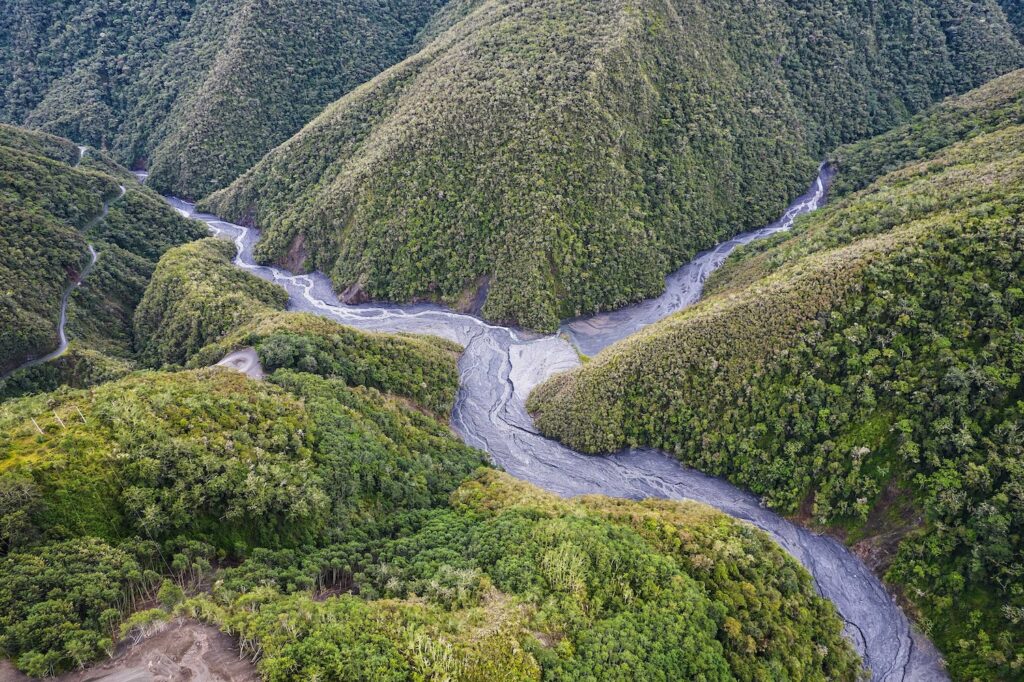
The Paucartambo Landscape is composed of steep mountain forests that form the headwaters of the Madre de Dios River.
Ancestral labour
The Inca Garcilaso de la Vega tells in his Royal Commentaries that it would have been Capac Yupanqui, who opened the door to the northwest of Cusco after defeating the Cuyos, to whom the town of Paucartambo belonged. It is said that these original settlers had as their major deity the apu Cañahuay or Qawaq ñawi, a mountain that can be seen on the entrance road to the Kosñipata valley and its exuberant mountain forests. The chronicler writes: “…. the prince went with such good success to the Paucartambo river, and passed in front of Challapampa and reduced the few Indians he found in that region. From there he went on to Pillcopata, where he had four towns populated by settlers. From Pillcopata he went on to Hauisca and Tunu, which are the first coca farms that the Incas had in the region.”
Luis Nieto and Eliana Llosa comment that “The coca leaf, as was to be expected given the enormous value it had for the ancient Peruvians, was a powerful magnet that attracted the Inca armies to the valleys formed by the tributaries of the Alto Madre de Dios… [its peoples] are mentioned for the first time in historical documents when they become part of the Inca empire’s coca-growing geography.” (Nieto Degregori, Luis ,and Llosa Isenrich, Eleana (2003). Manu through history. Pro-Manu Project. Lima) .
With the arrival of the Conquest and the discovery of the mines of Potosí, the demand for coca leaf skyrocketed and the Kosñipata valley was the main supplier of coca leaves; it is estimated that at least 30% of the production came from this place. It was a very profitable activity, as the chronicler Bernabé Cobo points out, “the most profitable in the Indies.” Another chronicler of the time, Pedro Cieza de León, wrote “there is no reason to think that in the world there has ever been any herb or root or tree-bred thing that was so highly valued.” While during the Inca period, coca leaf consumption was restricted to religious rituals, during colonial times it was the fuel that mitigated the tiredness and hunger of mine workers. For this reason, its consumption spread to all strata of Andean society.
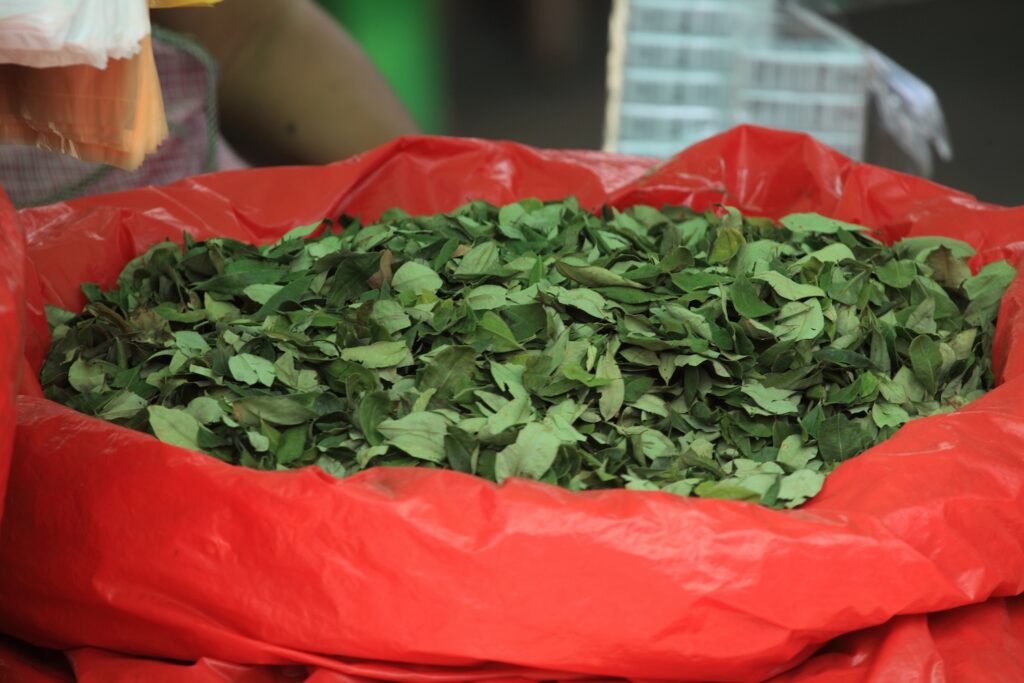
Traditional coca leaf consumption is a widespread activity in the Andes.
As Nieto and Llosa point out: “Coca production in Paucartambo was, therefore, gigantic. And it was so from the beginning of the Colony. Towards the end of the 16th century, some 19,000 baskets were harvested in the area, more or less a third of all the coca leaf produced in the Andes. And the Spaniards themselves calculated that it was about 50 times more than in the time of the Incas.”
Children of the Andes
With the advent of the Republic, coca leaf cultivation decreased drastically in Paucartambo, due to the arrival of products such as sugar cane, which replaced it to a large extent in colonial estates. It was in the 20th century that cultivation for traditional purposes began to pick up again, this time with the help of Andean migrants who occupied the Kosñipata valley from the mid-20th century onwards.
Currently, this region continues to supply 30% of the country’s legal coca leaf production, according to information from the National Coca Enterprise (ENACO), the state institution in charge of coca leaf collection throughout Peru. According to its 2022 annual report, Kosñipata has 329 registered legal producers, of which 203 are active, and produced 378 tons that year.
It should be noted that legal production, marginalised by drug trafficking, has been declining in recent years. In addition to the direct consumption of dried leaf, a widespread activity throughout the Andes, the leaf is used to make filter teas, flour, liqueurs, extracts, among other products, appreciated for their energizing qualities and high calcium and iron content.
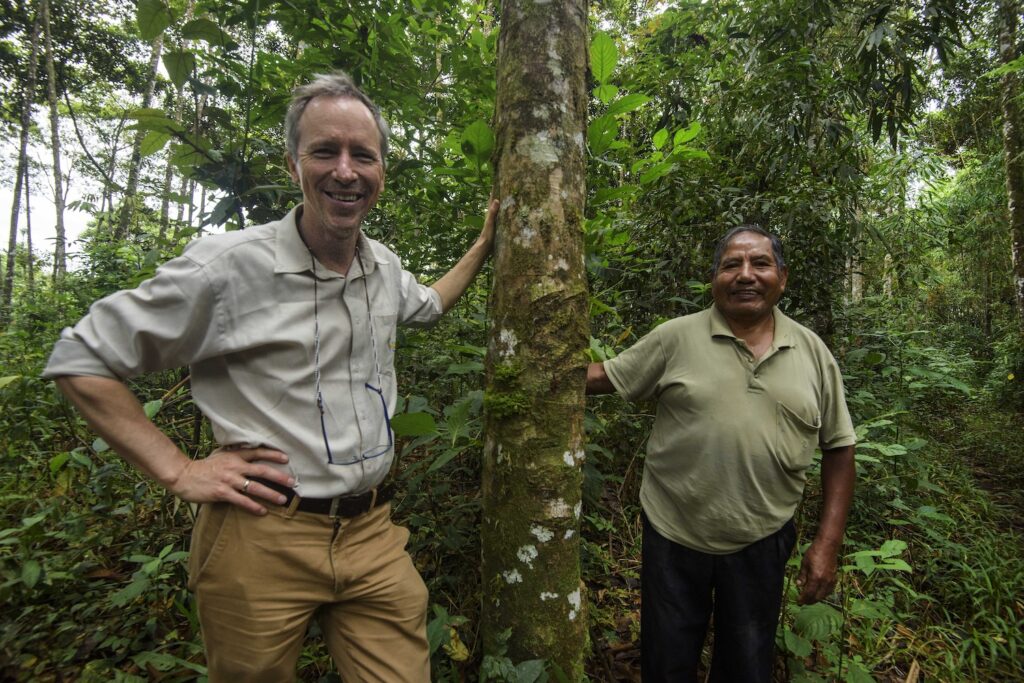
Don Nazario Huamán, farmer from the Aguanal sector in Asunción, with Frank Hajek, Regenera’s coordinator.
Today, faced with the advance of illegal economies and the violence and uncontrolled deforestation they leave in their wake, legal farmers like Mr. Nazario Huamán need to find new strategies to maintain their way of life. One is the conservation and valuation of the services provided by the primary forests that they still conserve on their land. As Frank Hajek, coordinator of Regenera, points out: “We have to support formal farmers so that they can make a living from their traditional crops and at the same time protect the lands of Paucartambo, giving them additional income options such as agroforestry and the commercialisation of ecosystem services. And that is what Regenera is for.”
Farmers committed to legality and the defence of their territories, like Mr. Nazario, understand that reforestation, the sustainable use of their resources, and the preservation of their remaining forests is key to the future. It is the key that will allow them to continue living off the land, providing a legal input of great importance to Peruvians, and contributing to the health of the planet.

Etiquetas
- Reforestation
- Legal coca plant
Artículos relacionados
- Regeneramos Juntos
- Abancay
- Machu Picchu
- Regeneramos Juntos
- Abancay
- Machu Picchu
Leer artículoLa hoja de ruta ambiental: cómo acompañamos este proceso
Margony Palacios